
RATLINKS: GOOSE VS. GEESE
How your favorite band became your favorite band, and what it costs to make that happen.

The sauna at my gym is hot in the specific way that loosens opinions. Ron has been in the sauna, by my count, since approximately the Obama administration. He has not been moved by a guitar solo since Watergate. On a Tuesday in April, the two of us are sweating onto the cedar bench, and I mention that I have an extra ticket to a band called Goose playing in Fort Lauderdale that night, and would he like it.
Ron tilts his head. He is processing.
“Goose?” he says. “I know Geese.”
I tell him no, Goose. Singular. A jam band out of Connecticut.
“Geese,” Ron says again, like a man correcting a waiter. “The Brooklyn ones.”
I sit there for a second, sweating. The thing is that Ron is wrong about the band. Goose and Geese are not the same band. They are not even the same kind of band. But the part Ron is right about, the part that does not leave my head for the next two days, is that he knows the name Geese in the first place.
Ron does not listen to new music. Ron does not have TikTok. Ron’s relationship to the indie rock industrial complex of Brooklyn, New York, is approximately the same as my relationship to the breeding cycle of the bottlenose dolphin. And yet Ron, on a Tuesday afternoon in April, in the shvitz, has produced from somewhere in the back of his head the name of a band whose entire existence to date is a Cameron Winter vocal performance, an album that came out last fall, and a Substack discourse most people I know who actually listen to indie rock are still catching up on.
Ron does not want the ticket. He shrugs the shrug of a man who has already filed the conversation under a heading he is satisfied with.
I call another friend and offer him the ticket who responds, I can’t but if it was Geese maybe.
As I drive to the concert I wonder how does everyone know Geese?
A few weeks ago, Wired reported that Geese, the Brooklyn rock band that The New Yorker called the best rock album of 2025, had hired a marketing firm called Chaotic Good Projects to manufacture much of their viral buzz on TikTok.
Five thousand dollars per song.
Hundreds of faceless accounts.
The piece was the kind of thing that, if you read it, you mention to other people. Other people mention it to other people. By the time the information reaches Ron, in some form, through some chain of nephews and articles and overheard conversations, the band’s name has migrated by one letter and become indistinguishable from a jam band his friend’s coworker is offering him a ticket to.
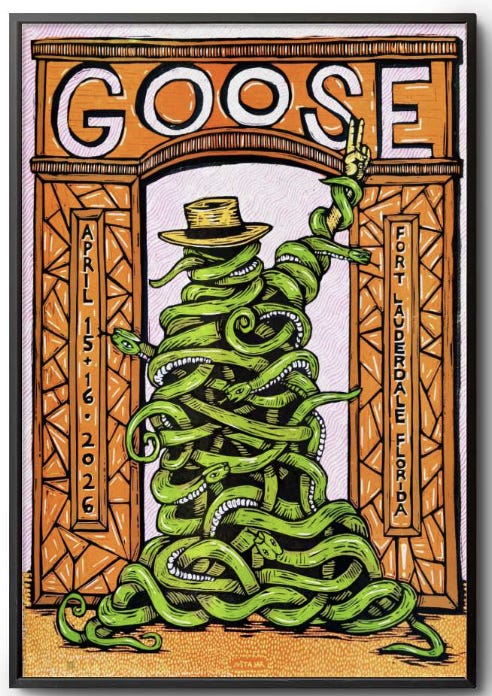
At the same time a different band called Goose was loading into the War Memorial Auditorium to play two nights. Goose. Geese. One letter. Two entirely different animals.
SAME OLD SHENANIGANS
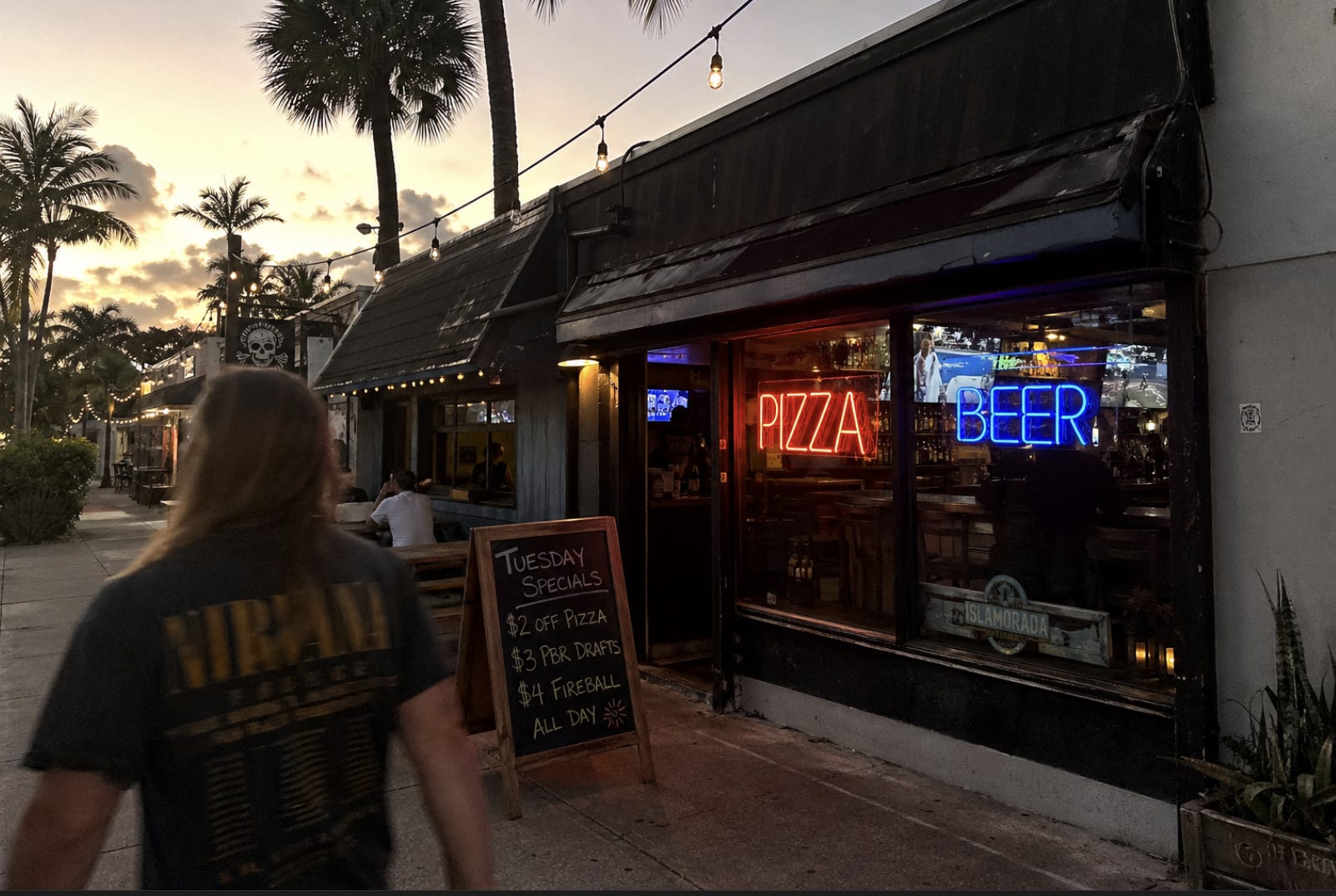
Patio Bar in Fort Lauderdale takes beer and sourdough pizza very seriously and almost nothing else seriously at all. On the night of April 14, the crowd was mostly locals, a few old-timers at the bar, a table of six women in for a birthday who were ordering frozen margaritas in a way that suggested it was the third stop, and one small pocket of guys in t-shirts older than their marriages who were using the place as a pre-game for the Goose show two blocks away. I was in the pocket. Someone had left an issue of The Proprietor on the bar. I did not pick it up. Nobody else at the bar seemed to know or care what Goose was, which is the correct ratio at a pre-game and the wrong ratio at a Geese show.
Years ago, I heard Goose for the first time from a coworker. He was driving. I was in the passenger seat. It was a hot summer night in New York City, windows down, and blasting “Royal.”
Inside the auditorium, the floor was ninety percent male. Every man in the room had the same chilled-out, sloth-like expression, the kind you see on people who have decided that whatever happens next is fine. The music hit them like weather. Eyes closed. Hands loose. Faces rearranging themselves into something pre-verbal, then sub-verbal, then geological. I have been to church. This was closer.
The crowd was also, uncannily, familiar. I turned around during Set 1 and recognized a guy from a birthday party I had been at the night before. We nodded. He went back to his trance. A few rows up, my friend’s eye doctor was very deliberately pretending he could not see me from behind his glasses, which felt, given his specific job, like an admission. Goose’s audience is two-and-a-half degrees of separation from itself. In any direction you turn, you are friends with somebody’s brother-in-law, somebody’s accountant, or somebody who once briefly dated your friend’s sister.
The Set 2 closer was “Green River.” Creedence Clearwater Revival. For the first two minutes it was faithful enough that I was convinced the crowd was going to file out of the auditorium, climb into a Dodge Rambler, and drive to a river somewhere to wash a shirt. Then the song unspooled sideways into “Loose Ends,” the jam building in layers, synth on synth, the Rambler disappeared and a Miami nightclub took its place. The band did not finish “Green River.” They never do. A jam band that finishes a cover is a jam band that has lost confidence in its audience.
474 SHOWS
Night two, they pulled out “Kung Fu Fighting.” Carl Douglas, 1974, for twelve full minutes, everyone was kung fu fighting, dunna-dunna-dun-dun-dun. The first time they had played it in 474 shows. That is a sentence that means something only to people who know it means something, and those people had been in the auditorium for sixty minutes already, vibrating.
Somewhere in the middle of the set, the taper community on Reddit noticed that the first letter of every song on the night’s setlist spelled SUCK IT STORM. A hidden message. Aimed at a blogger named Ryan Storm, who had posted a hypercritical review of the previous night’s show. The band never mentioned it from the stage.
ALAN FREED DIED FOR THIS
In 1960, a disheveled disc jockey named Alan Freed sat before the U.S. House Oversight Committee and refused to sign an affidavit swearing he’d never taken money to play records.
Three hundred and thirty-five other DJs had already folded, admitting to a combined $263,000 in “consulting fees,” which is the cleanest euphemism in the history of American jurisprudence.
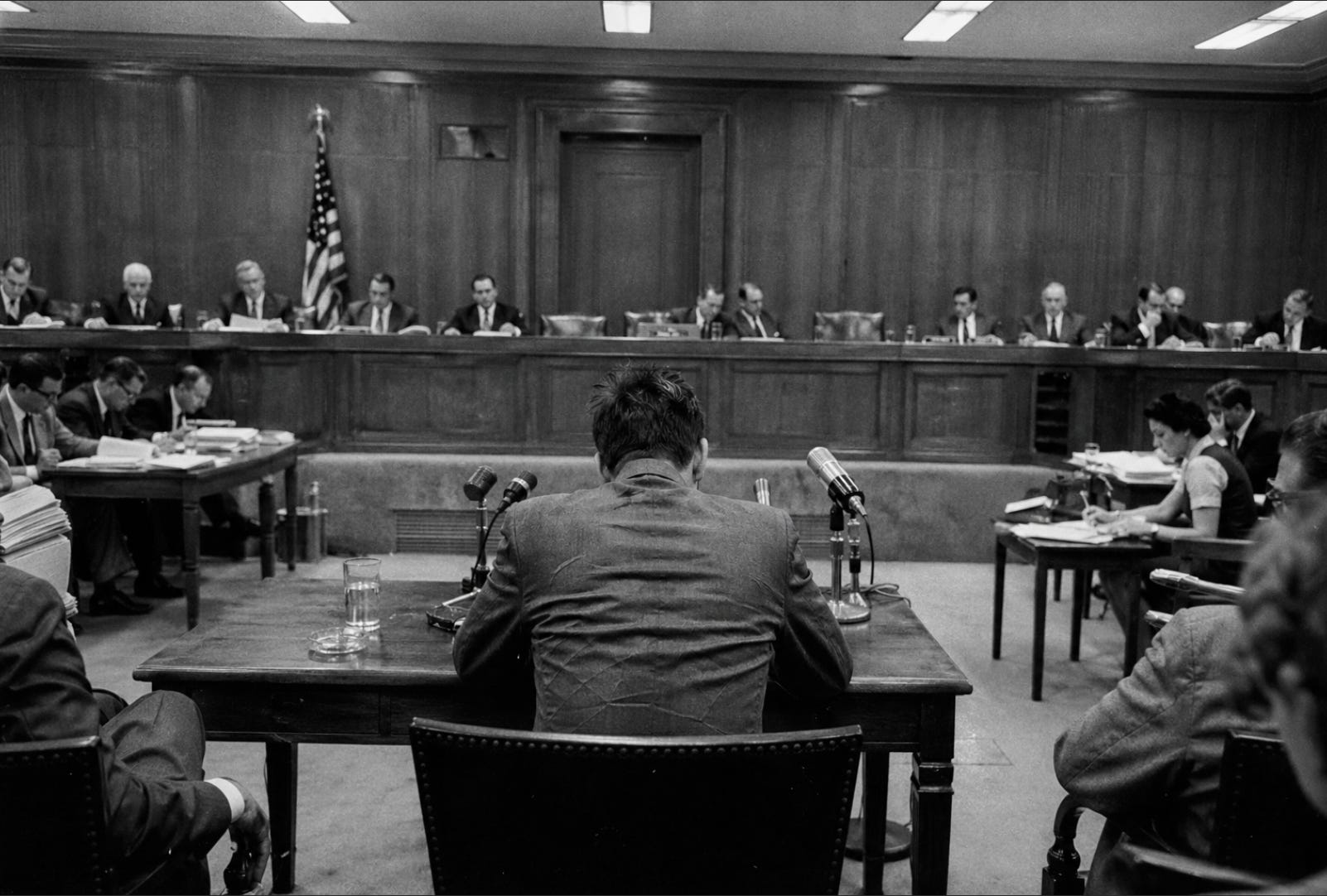
Freed, who coined the term “rock ‘n’ roll,” chose principle. He was charged with twenty-six counts of commercial bribery. He died five years later, broke.
Dick Clark, who owned pieces of seven indie labels, six publishers, three record distributors, and two talent agencies, divested everything before his testimony. He showed up in a pressed suit. He smiled. He walked out clean. Chairman Oren Harris called him “a fine young man.”
Two men. Same crime. One got destroyed. The other got American Bandstand.
Congress made payola illegal that year. The 1960 amendments to the Communications Act drew a bright line: take money to promote music on a broadcast platform, you disclose it or you go to jail. The law still exists. As recently as 2006, Sony BMG, Warner, and Universal paid a combined $12.5 million to the FCC for breaking it.
That was payola. The rest of us are about to feel stupid.
The $5,000 Song
In late March 2026, the co-founders of a marketing firm called Chaotic Good Projects sat down for a Billboard podcast at SXSW and explained, on the record, how they break artists.
The firm runs networks of hundreds of TikTok accounts. Meme pages, sports clips, aesthetic feeds, cooking videos, golf highlights. None with faces. None disclosing who pays them. When a client signs up, the accounts post content with the client’s music in the background. Not as ads. As things that look like they happened to a guy with an iPhone who didn’t know he was being recorded.

Co-founder Andrew Spelman gave it a name that deserves to be framed in every marketing classroom in America: trend simulation.
“We can drive impressions on anything at this point. We know how to go viral. We have thousands of pages.”
“Everything on the internet is fake.”
The client list per Billboard reads like a Coachella undercard that aged into a headliner. Geese. Wet Leg. Mk.gee. Tame Impala. Coldplay. Travis Scott. Mitski. Dijon. Oklou. Justin Bieber. Dua Lipa. When an SNL performance drops at midnight, Spelman’s accounts flood the comments with a hundred posts saying it was the best performance of the year, before any actual viewer has formed an opinion. The first comment becomes the consensus. The consensus becomes the take of people who haven’t pressed play.
Two artist managers told Billboard the going rate is roughly $5,000 per song. The difference between this and 1959 is not scale. It is legality. There is no FCC for TikTok. When the gatekeepers were DJs, we made laws. When the gatekeepers became code, we made nothing.
Somewhere in this network, a faceless account posts a fourteen-second clip of someone making carbonara. A Geese song plays underneath. Ron does not see the video. Ron’s nephew sees it. Ron’s nephew mentions Geese at a barbecue. Ron files it. Two weeks later, in a sauna, the name comes back out.
That is the supply chain. You are also in it. So am I.
SINBAD IN A MOVIE THAT DOES NOT EXIST
In the late 1990s, the comedian Sinbad starred in a movie called Shazaam. He played a genie. There is no such movie. There never was. Sinbad has spent thirty years explaining this to people who remember it vividly. They remember the cover of the VHS. They remember the scene where the kids find him in a lamp. They will describe the kids. They will describe the lamp. None of it exists.
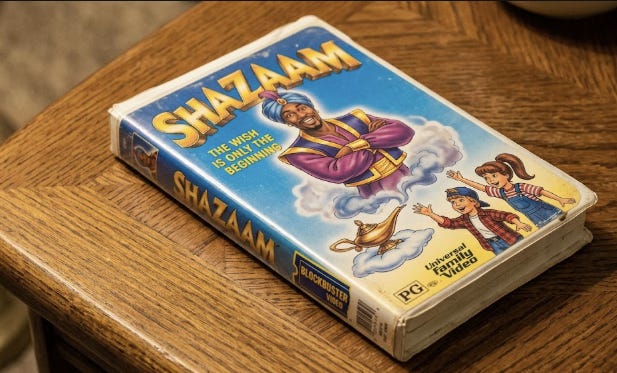
The brain, given a plausible cultural artifact and three or four peer confirmations, will manufacture the experience of having encountered it. The technical name is the Mandela Effect, after the not-insignificant population of people who clearly remember Nelson Mandela dying in prison in the 1980s, an event which did not happen and which Mandela himself, when alive in the 2000s, found puzzling.
The Mandela Effect is not a bug in the trend-simulation system. It is the product. The whole point of seeding hundreds of accounts is to produce, in the consumer, the memory of organic discovery. If it works, the consumer doesn’t just believe the band is good. They believe they found the band themselves. In three years, they will tell you, sincerely and incorrectly, that they had a tape of Getting Killed before anyone they knew. There was no tape. The discovery was placed in their feed. The feeling was real. In an attention economy, the feeling is the only part of the transaction that matters.
B-SIDE: WILTON HIGH
While Geese was being trend-simulated from a Brooklyn phone farm, Goose was doing something considerably less sophisticated. They were playing their high school.
In April 2024, Goose returned to Wilton High in Wilton, Connecticut, where three of the four members graduated. Two sets in the David F. Klune Center for the Arts. One for students in the afternoon. One for teachers in the evening. They pulled out a “Ghostbusters” cover they had not played in 365 shows. The road crew walked the AV kids through sound design. The whole thing was free.
Goose formed in Fairfield County in 2014. They cut their teeth at O’Neill’s in Norwalk and BRYAC in Bridgeport. They built their following the way jam bands have built followings since the Carter administration: by touring relentlessly and letting fans trade recordings. A community who track setlists with the obsessive precision of day traders, except instead of trading shares they’re trading the exact length of a “Hot Tea” jam from a Tuesday in Asheville.
By June 2025, the band sold out Madison Square Garden. This year, they’re releasing their sixth album, BIG MODERN!, a record about the overstimulating, hyperconnected world of content streaming into your brain in real time, all the time.
The marketing campaign was: hire actor Jake Lacy to play a deranged record exec yelling at the band, put up guerrilla signage in a few cities, launch BIGMODERN.com which communicates exclusively in Morse code, and then sit courtside at a Knicks game in matching yellow sweatsuits that spelled out F-A-C-E.
It was absurd. It was transparent. It was obviously marketing. Nobody called it a psyop because they never pretended it wasn’t.
This is, incidentally, the same operating principle behind a small Hudson Valley quarterly called The Proprietor, the one that just came back from an eleven-year hiatus with a cover story about the last summer at the Concord Hotel and a piece by E. Parrish on a Kingston tavern that has had the same trout on the wall since 1895. The advertising in there is the marketing. There is no fourth wall to break because there was never a fourth wall.
THE TASTE HEIST
A Substack writer and working musician named Eliza McLamb cracked the Chaotic Good story open before Wired picked it up. Her piece was called “Fake Fans.” The names that made indie music readers choke on their natural wine were not the pop stars. The pop stars are supposed to have machines behind them. The problematic names were Dijon. Oklou. Wet Leg. Jane Remover. The artists you thought you discovered.
That is the part that stings. Not that marketing exists. Everyone knows marketing exists. What stings is the specific illusion that got punctured: the idea that your taste is yours.
The whole identity of being an indie music fan is built on the premise that you found something before it was popular. That your Spotify Wrapped says something real about who you are. That the gap between what you listen to and what the algorithm feeds everyone else is evidence of your discernment. Chaotic Good didn’t simulate trends. They simulated taste. They made the discovery feel organic so the audience would invest its identity in it. Identity, once invested, is the most durable form of brand loyalty ever invented.
A writer at Consequence of Sound ran a rebuttal arguing this is just shelf placement. Cereal companies pay for eye-level. Structural problem, not fraud. When Cheerios pays for shelf placement, you know you are in a store.
Trend simulation works because you do not know you are in a store. You think you are at a party. You think a friend is telling you about a great band. The friend is a meme page run by a marketing firm with a lot of phones, and you are wearing the band’s shirt by next Saturday.
Geese is a good band. That fact makes this story more interesting, not less. Cameron Winter sings like a man trying to escape his own vocal cords. The band recorded Getting Killed in ten days at Kenny Beats’ studio in Los Angeles while the city burned. None of that is fake. The uncomfortable question is not whether Geese is a fraud. It is worse. The uncomfortable question is whether, in an ecosystem where 100,000 songs are uploaded to streaming services every day, it is even possible to find anything without someone manufacturing the discovery for you.
BUILD YOUR OWN PSYOP
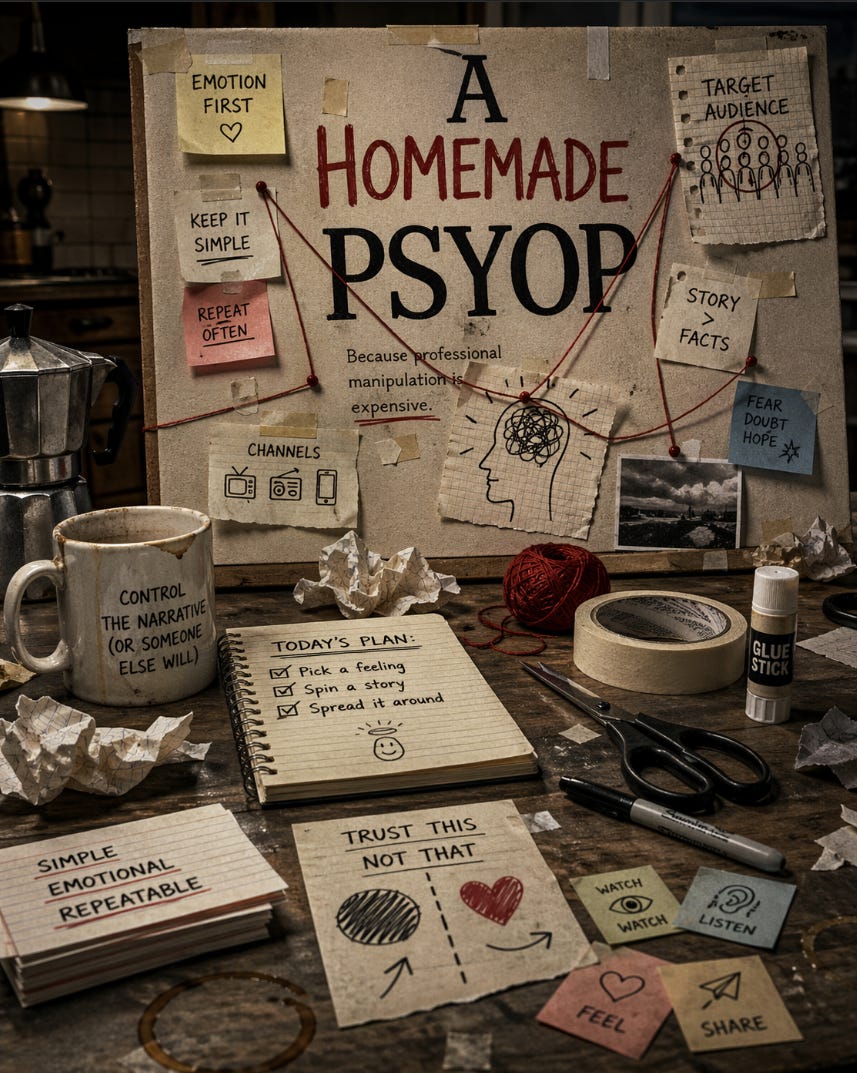
Everything Chaotic Good does is now a playbook anyone can run. The tools are free. The tactics are documented. The co-founders explained the whole thing on a podcast for forty-five minutes. Five steps.
One. Sell a feeling, not a thing.
Geese did not sell rock music. They sold the feeling of having found a band before your friends did. Glossier did not sell moisturizer. It sold the feeling of being the kind of woman who already knows about Glossier. Liquid Death did not sell water. It sold the feeling that drinking water at a hardcore show was funny. Pick a longing your audience cannot quite name. Name it. The thing you are selling is a relief from the longing. The product is the receipt.
Two. Aim at a high school, not a country.
Not a demographic. A subculture. People who already use the same five words for the same three things. A psyop aimed at “men 35–54” hits no one. A psyop aimed at “people who own a Filson tote and have opinions about which deli serves which kind of mustard” hits with the kind of precision the Defense Department would call adequate. You don’t need a million people to believe a thing. You need eight hundred of the right people to believe it loudly. Loud beats large.
Three. Make the artifact too good to be a bluff.
Most homemade psyops die here. The bar is not “fools a tired person scrolling at midnight.” The bar is “a real version of this would be jealous.” Logo, copy, photography, paper stock. If you cannot clear that bar, shrink the psyop until you can. A perfect matchbook beats a half-drafted magazine. A perfect single-page menu beats a half-drafted restaurant. Authenticity in 2026 is a production value, not a virtue.
Four. Plant it where things are found, not where things are sold.
Skip the ad slots. Ads carry a tax on belief. Discoveries do not. Drop the artifact into the kind of group chat screenshot, podcast comment thread, mood board, or face-down-on-a-bar moment where your audience already expects to encounter new things. The single act you are paying for is the first stranger introducing the artifact to a second stranger. After that, you stop touching it. The thing is operating now without you.
Five. Wait for the Mandela.
Three to six months in, somebody you do not know will tell you, in an unrelated conversation, that they have heard of your thing. Possibly that they have used your thing. Possibly that they grew up with it. None of which is possible. That is the signal. The psyop has stopped being something you operate. It is now something the world remembers. Scale, monetize, reveal, or quietly retire. Your call.
Now Look Back at This Essay
Count the times the word Proprietor has appeared. The first one, sitting face-down on a bar in Fort Lauderdale, you skimmed. The second one, in this paragraph, you are wondering whether you have actually heard of it before.
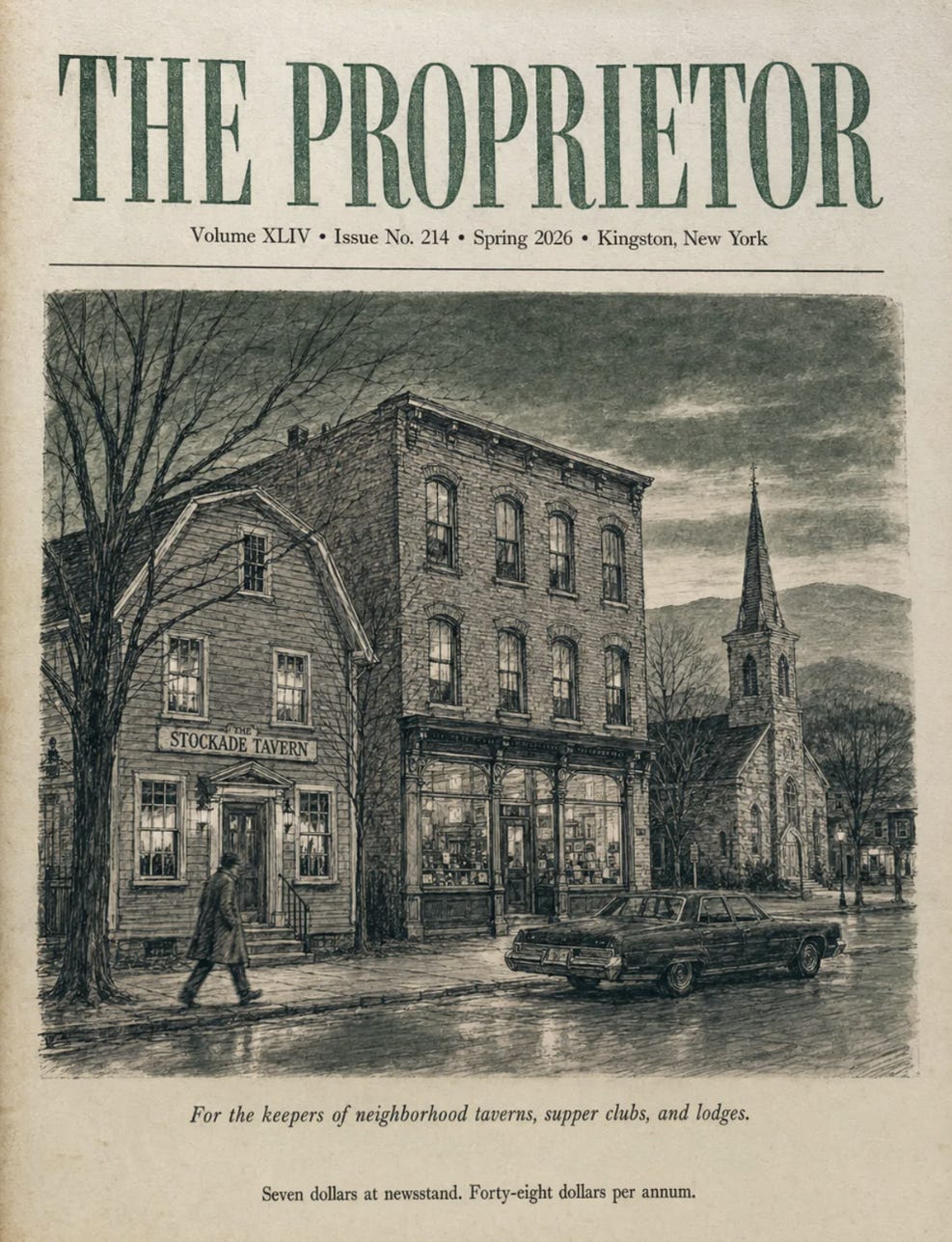
You have not. There is no Issue 214 of The Proprietor sitting face-down on the bar at Patio Bar, although there will be by August. There is no editor’s letter from Box 214 in Kingston. Ron has not, in fact, mentioned it to me in the sauna. Yet.
By the time the next Field Note publishes, three of you will have told someone you read about The Proprietor somewhere. Two of you will swear you saw it at a friend’s apartment. One of you will remember the cover. An ink drawing of a tavern in Kingston at dusk, a Cadillac at the curb, a man in a coat walking past, the steeple of a church in the distance. Which the magazine has not yet printed, because the magazine does not yet exist.
Except, technically, it does. Issue 214 is at the printer. Forty-eight pages. Concord green ink on Mohawk Via Cream. Subscriptions are $48 a year, four issues, mailed by post from Box 214 in Kingston.
You can order one. When it arrives, you will have a hard time remembering whether you knew about it before reading this essay. Some of you will be sure that you did. A few of you will write in to correct the magazine on a detail you remember from a back issue. The magazine has not printed a back issue since 2015. You will be very specific about the year.
You will be incorrect. That, also, is the point.
ENCORE
After the second Goose night, we walked back to Patio Bar. Same beer. Same sourdough. My buddy wandered off toward the back of the bar to find the bathroom and stopped halfway there to read a chalkboard sign propped on a stool. He read it. He read it again. Across the room, the manager looked up from the register, clocked which sign my buddy was reading, and shouted, with the casual affection of a man who knows his neighborhood:
“You trying to get your butthole waxed?”
The offer was sincere. The chalkboard was advertising a weekday special at a manscaping place upstairs. My buddy stood very still. The bar got way quieter than it should have.
You cannot manufacture that. No package at Chaotic Good produces a bar manager shouting hair removal across a room at midnight after a twelve-minute “Kung Fu Fighting.” That belongs only to people who were actually there, which is the last unmarketable thing left in the attention economy and probably the only reason anyone still leaves the house.
A few weeks from now, someone at the gym will tell me about a piece in The Proprietor he read years ago. About the Concord Hotel. About which year the Imperial Room stopped serving a particular green cocktail. He will be very specific about the year.
“I had a subscription to that, what, ten years ago?” he will say.
He did not.
It is working on you right now.
The Proprietor. Issue 214. proprietor.ratlinks.com