
RATLINKS: COCKTAIL MATH
On Napkins, Systems, and the Only Thing That Actually Matters

In the last year I built a system. The system works like this: build something fast, ship it to real people, watch what they do with it, kill what doesn’t pull, double down on what does. Repeat nightly.
The system has produced over sixty products. An AI consulting company. A legal SaaS platform. A golf gambling book. A mah jongg strategy guide because a mom asked and the market was right there. A towel and linen rental company built from a Royal Caribbean cruise ship stateroom while my wife took photos of sunsets I apparently witnessed and do not remember.
Most of them were singles. Some were strikeouts. One of them made a group chat lose its mind. This is the story of that one, and of the tweet that told me what to do about it.
LINEN MEETS LINEN
James Shields, a guy on Twitter with 26,000 followers who posts about scaling boring businesses:
“The best business in the world is selling something nobody thinks about to customers who never switch. The moment your business is interesting enough to talk about at dinner, someone will try to copy it. I sell napkins. Nobody copies me. Nobody wants to.”
Two months ago I built a towel company. Now I’m reading a napkin salesman’s manifesto at midnight nodding like he’s describing my future. The universe has a textile theme going and I’m choosing not to ignore it.
Shields’ theory sounds small. Napkins. Who cares. But Cintas, the company that actually sells napkins and shop towels and mop heads and those embroidered polos you didn’t ask for but now own seven of, does $9 billion a year. Nine billion dollars in revenue from products that nobody has ever once described as exciting. Their stock has quietly outperformed most of the Magnificent Seven over twenty years, which is especially impressive when you consider that their product is, at its core, a clean rag.
WHAT’S YOUR AI STRATEGY, REALLY?
I know about Cintas because I walked up to their COO at an investor conference and asked him a question that, in retrospect, had the energy of a guy at a house party asking the host if he’s considered rearranging the furniture.
“What’s your AI strategy, really? And can I help?”
To understand why I thought this was a reasonable thing to say to the chief operating officer of a $9 billion company, you’d need to know that I had, forty-eight hours earlier, built him an entire competitive linen logistics platform from a cruise ship. AI phone agent. Churn prediction. Route optimization. The works. I had been building dangerously for weeks and showing no signs of stopping.
He was gracious. He was interested. His director of product development scheduled a call with four colleagues, including the CTO. For about a week I was the guy who might be selling AI to Cintas.
Then I wasn’t.
Cintas figured out linen logistics during the Coolidge administration. They have a guy. The guy has a guy. That guy’s guy has been servicing the account since before you had a reason to exist. They liked what I showed them. They believed they could build it themselves. Maybe they could. I positioned myself as a partner. They saw a vendor. They already had plenty of those.
The rejection stung for about an hour. Then it became the most useful data point the system ever collected.
Big companies don’t need you. Not because your product is bad. Because they have a dedicated IT department whose entire job is to not need you. But the restaurant group still replacing napkins the way they did in 1997? They don’t have a that. They likely don’t have a consultant who shows up on Tuesdays and asks how business is going.
Build something that makes them a “Tuesday guy.” That makes their job so much easier he can’t shut up about it and his entire client roster becomes your sales pipeline. He doesn’t sell your product because you asked him to. He sells it because it made him look like a genius, and looking like a genius is the highest-margin activity in consulting.
FOUR PDFs AND A GROUP CHAT THAT WENT OFF THE RAILS
A few weeks before my annual member-guest, I started worrying about the thing every member-guest participant worries about: what if my partner cancels?
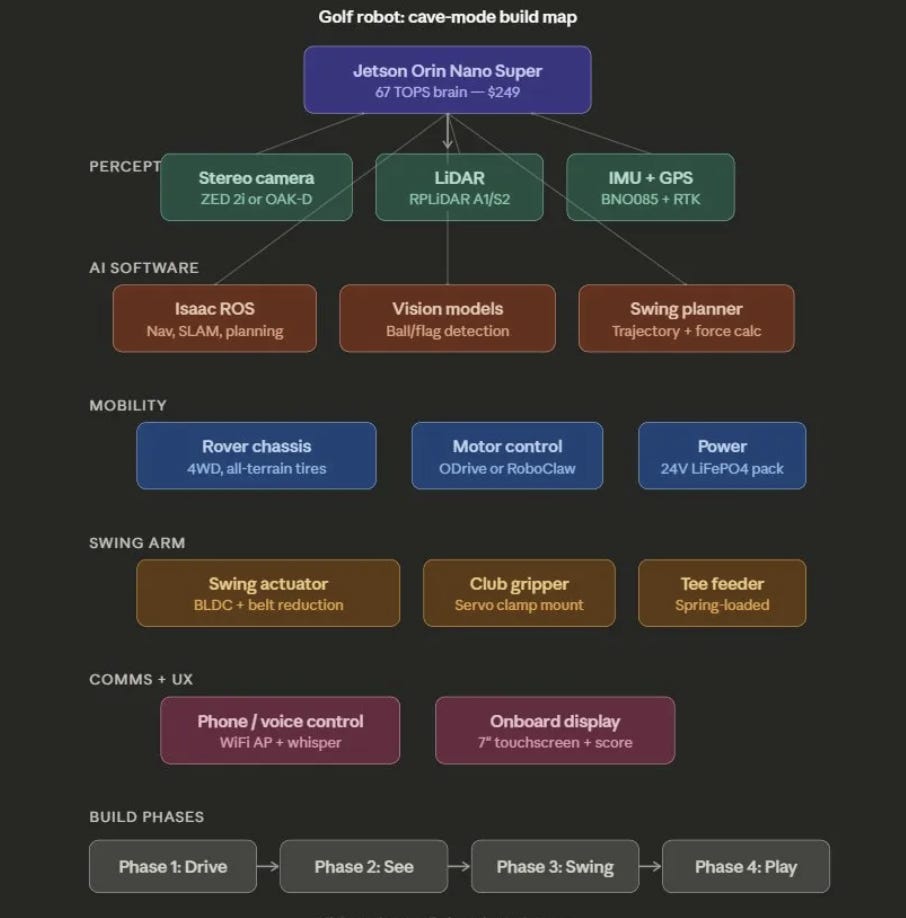
Rather try to find a replacement. What if I built a replacement? Spec-ing out a full engineered design for a golf-playing robot. Jetson Orin Nano Super brain. LiDAR for ball detection. A spring-loaded tee feeder. Four build phases.
My partner didn’t cancel but still I internally debated what people would say if I brought a robot to the first tee. I knew after my robot lifted me and the title that half the field next year would be made of metal.
NEXT ON THE TEE
Before the round the GM sent four files. Flights. Handicaps. Rules. Schedule. Our team was seeded 47th out of 48, which is the kind of ranking that either breaks your spirit or frees you entirely from the burden of expectations. I chose the second one.
The documents were the kind that normally get printed, three-hole-punched into a binder, and fought over for four days while everyone drinks too much and insists their handicap is legitimate. If you’ve played in a member-guest you know the binder. If you haven’t, imagine a fantasy football draft run by guys in golf shoes who are three beers deep by 9 AM.
I turned the email into a prompt. Uploaded all four files to Claude. Out came a working product. Every team, every format, every bet, updating hole by hole on every phone through a shared link. No app. No download. One URL.
Then I sent it to the GM. The GM sent it to his group chat.
The group chat lost its mind.
Guys I hadn’t shown the product were asking me about it. How did they find out? Members I barely knew reached out wanting to use it at their own events. The tournament hadn’t started and people were already arguing about whether their team was getting fair odds, which is exactly what you want to see because arguing about odds is how golfers say I love you.
I guess this is what product-market fit feels like.
In 2007, Marc Andreessen, the guy who co-invented the web browser, started a blog and wrote with the energy of a man who’d been bottling up two decades of startup wisdom. Ten months later he deleted the whole thing. Fans rescued the posts from the Wayback Machine. Inside was an idea he credited to Andy Rachleff of Benchmark Capital: of team, product, and market, market always wins. The corollary he called the only thing that matters: product-market fit. The moment a market wants what you have so badly it starts pulling the product out of your hands.
I’d spent a year pushing products at people. Sixty of them. This was the first time something pulled. And it pulled before anyone teed off.
WHY I SAW IT AND YOU WOULDN’T HAVE
The group chat didn’t go crazy because I’m good at prompting AI. Any idiot can prompt AI. I have sixty URLs that prove it.
The group chat went crazy because the product knew things. It knew that a Nassau has three bets running simultaneously. It knew how carryovers work in Skins. It knew that Wolf requires a decision after every tee shot and that most groups get the rotation wrong by the fourth hole. It knew all of this because I’d spent years learning it the hard way and then writing it down.
Peel and Eat. My book about golf gambling. Twelve formats. Every edge case. Every argument that has ever erupted on the 18th green when nobody can agree on whether the press was still live, which, for the record, it was, and Dave still owes me forty dollars.
Andreessen wrote about luck, drawing on a neurologist named James Austin who classified it into four types. The third is the luck that finds the prepared mind. It only visits people who’ve spent so long in a domain that when the opportunity shows up they recognize it before anyone else in the room even looks up from their phone.
That book forced me to codify knowledge that lives entirely in the oral tradition of guys who’ve been gambling on golf for decades and whose idea of documentation is a pencil behind the ear and a napkin in the back pocket. The codification became a scorecard app. The app became a prototype. The prototype became what happened when those four files hit my inbox.
I didn’t see documents. I saw the product I’d been unknowingly building for years.
NAPKIN ECONOMICS
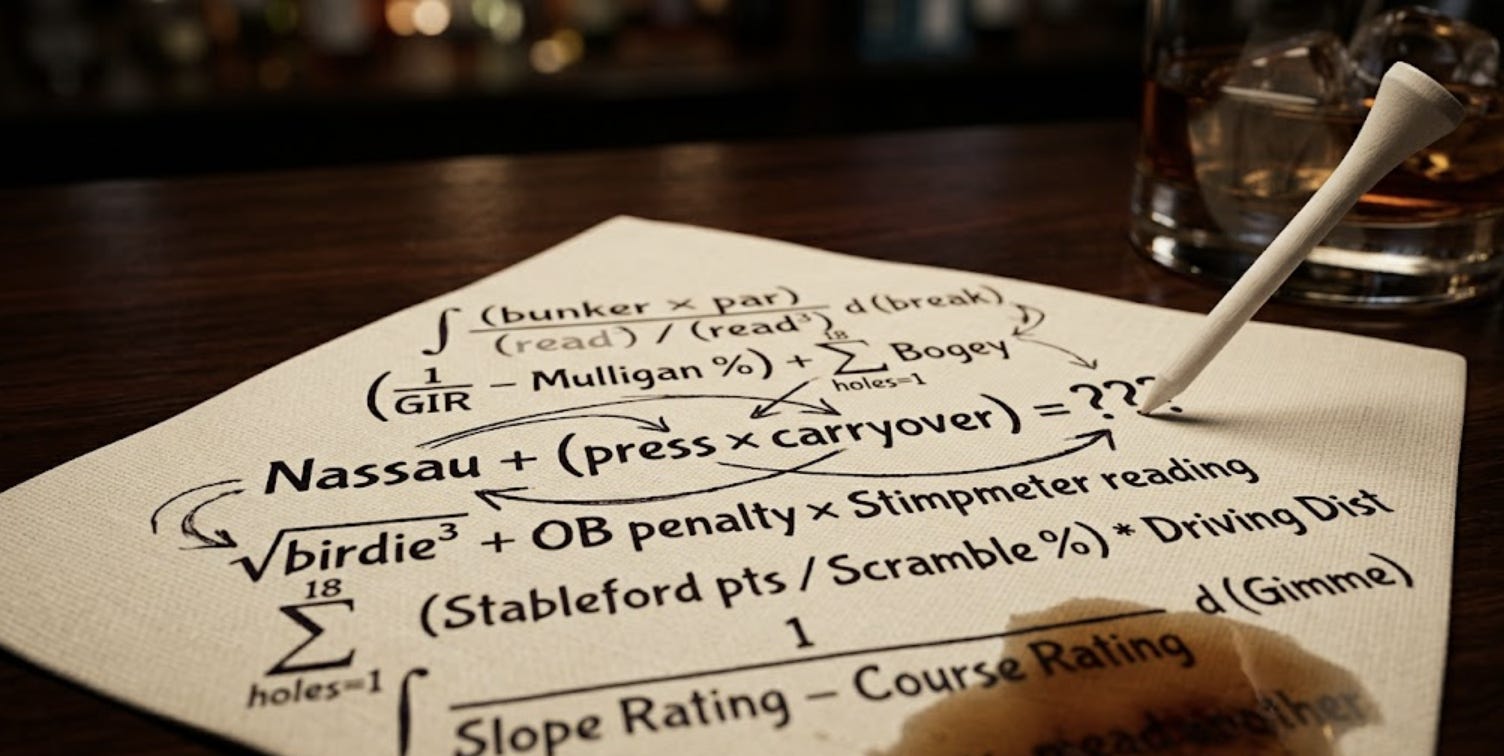
Every golf trip in America settles up on cocktail napkins. Side bets scratched on beverage cart receipts. Settlement math happening in a group text at 11 PM Sunday fueled by bourbon and the kind of selective memory that would make a defense attorney proud. Someone remembers a press nobody else agreed to. Venmo requests arrive with the description “golf stuff” and an amount that seems either too high or suspiciously low.
The apps that exist for this were built by sportsbook people who think the problem is I need an app with odds. Golfers don’t need odds. Golfers need to know who owes what before someone’s wife asks why $340 just left their Venmo account.
BetWaggle grew out of that member-guest site. Same bones, bigger ambition. The goal is to be the software you use at a charity scramble and wonder where it’s been all your life. You use it on your boys trip that October. Then you use it every Saturday because a round without it feels like keeping score on the back of a receipt again and you can’t go back.
One person sets up the outing. Everyone joins through a link. Scores update hole by hole. Settlement is automatic. Venmo deep links. Drop the card in the group chat.
A calculator that keeps friends friends.

Next month I’m taking it to McKilmore outside Atlanta. Eight guys, four days, twelve formats, zero cocktail napkins. First real field test with real money and real egos, which in golf are functionally the same thing.
Every charity scramble has an organizer drowning in pairings and a poster-board leaderboard updated with a Sharpie every twenty minutes. Make that disappear and she tells every other organizer she knows. From scrambles to buddy trips. From buddy trips to every round. Lifetime records. You’re 4-7 against Dave in Nassau but 11-3 in Skins, which Dave will hear about at every single opportunity for the rest of his natural life.
SIXTY SWINGS AND A NAPKIN
Andreessen cited a psychologist named Dean Simonton who found that Beethoven’s most celebrated years were also his most embarrassing. The hit rate never improves. The only variable is volume.
Sixty URLs. Plenty of volume. Plenty of garbage.
But Andreessen’s volume argument and his product-market fit argument pull in opposite directions. One says keep swinging. The other says the only thing that matters is one thing. The word is “only.”
Building is the drug. Shipping is the high. A group chat losing its mind over a product that didn’t exist twelve hours earlier is a rush that no amount of self-awareness fully discounts. But sitting with one product and grinding through sales calls and pricing tweaks and the “why did that tournament director stop responding” forensics? That’s the comedown. That’s the work nobody screenshots.
The system I built over the last year wasn’t random. It was a machine for finding out what matters. Sixty products went through it. The system watched what pulled and what didn’t. It learned from the Cintas rejection. It learned from the group chat. It learned that a mah jongg guide is a nice single and a golf sportsbook that makes strangers argue about odds before anyone tees off is something else entirely.
The system also helped build this piece. The same process that produces products, build fast, test against real people, watch what resonates, produced the article you’re reading. If the system works, you’ll share this with a golfer you know. If it doesn’t, I’ll know what to fix by morning.
The system says napkins. I’m listening.
They say you know product-market fit when you see it. I know what it sounds like. It sounds like forty guys arguing about odds in a group chat you didn’t start.
It’s time to collect.
¡Quédate sediento, mis amigos!
If you play golf and you’ve ever argued about the math, BetWaggle exists because of you. Free for casual rounds. $32 for buddy trips. $149 for outings and member-guests.
RATLINKS RECAP
@scaling_shields, the napkin philosopher
The Pmarca Blog Archives, free, still essential
Peel and Eat, a gentleman’s guide to gambling on golf
BetWaggle, the sportsbook for your golf group
Build Dangerously, last month’s edition