
RATLINKS: PROOF OF WORK
Why the smartest bet in America isn’t about predicting the future. It’s about betting on what people think they already know.

THE 75¢ DOLLAR
The tab has been open for three days.
Kevin Warsh to be the next Federal Reserve Chair. Seventeen cents when I bought. Now it’s down to fourteen. The other choice - Kevin Hassett - was at thirty-something when I wasn’t paying attention. Now it’s forty-five and climbing.
Every few hours I click over and watch the numbers. Warsh: 14. Hassett: 51. The spread getting wider. My thesis getting weaker.
This is the moment I’m not supposed to talk about. The moment between placing a bet and knowing if you’re a genius or an idiot. The moment when you’re checking the price too often, reading every rumor for confirmation, asking yourself the question that determines everything:
Am I throwing good money after bad?
I keep thinking about the guy who didn’t flinch.
I.
Three weeks before the 2024 election, a Frenchman paid for a poll that asked the wrong question the right way.
Not “who are you voting for?” Americans lie about that, politely, to avoid the conversation. He asked: Who do you think your neighbors are voting for?
People will lie about themselves, but they will gossip honestly about everyone else.

The results came back overwhelmingly for Trump. The polls said toss-up. The prediction markets said 55 cents. The neighbor poll said 85 percent.
His name was Théo. He set down his espresso and started liquidating.
II.
Stocks were sold first. Next bonds. Then whatever could be converted to USDC stablecoin and deposited into Polymarket, an offshore prediction exchange that American regulators had tried and failed to kill.
He opened eleven accounts with names like Fredi9999. Theo4. PrincessCaro. Michie. By election day, he had $80 million riding on Trump.
His wife didn’t know. His friends didn’t know. His colleagues at the French bank where he traded didn’t know.
Election night, somewhere outside Paris, he watched CNN alone. The anchors discussing “razor-thin margins.” Théo watching his net worth move by millions every time a county reported.
Florida broke early. Then North Carolina. Then it was obvious.
Eighty-five million dollars materialized on a screen. And he had no one to tell.
III.
I’m not Théo. I don’t have $80 million. I have a Kalshi account and a position in Kevin Warsh that’s currently underwater.
But I’ve had the other thing. The moment when the screen changes and you realize you were right.
Earlier this year, the government shutdown was dragging into its third week. I was on my couch at 11pm, half-watching Erin Burnett talk about furloughed workers, when I saw the contract:
“Will the shutdown end before day 44?”
Trading at 38 cents. Better than a coin flip.
I didn’t buy immediately. I sat there thinking. TSA agents weren’t getting paid. Air traffic controllers weren’t getting paid. And every day this continued, the security lines at airports got longer.
Here’s what I knew about politicians: they can survive bad press, angry voters, almost anything - except flight delays during a holiday weekend. The moment LaGuardia becomes a parking lot and CNN shows footage of families sleeping on terminal floors, the shutdown ends. Not because anyone’s principles changed. Because the pain got too visible.
I bought in for 37 cents.
The next two weeks, I checked the price more than I should. Watched the news differently - not for what politicians were saying, but for what the TSA lines looked like. Every story about airport delays felt like money.
When it hit 78 cents, I sold half. Locked in the profit. Let the rest ride.
When the shutdown ended. The contract settled at 100.
I didn’t predict the future. I just noticed that TSA agents have rent to pay and Congress has flights to catch.
IV.
That bet was in the Boring Middle. The zone between 65 and 85 cents is where the real money lives.
Below 65, you’re buying lottery tickets. Trump at 5% before the primary. Bitcoin at 100-to-1. The dreamers cluster here, subsidizing each other’s hope with money they’ll never see again.
Above 85, you’re buying pennies. The returns are too thin. Algorithms dominate, arbing away fractions of profit while humans sleep.
But that middle zone is where contracts get mispriced. The probability is high enough that homework works. The payout is fat enough to justify the sweat. A contract at 75 cents that’s really worth 95 is a dollar bill selling at a discount.
That’s the 75¢ Dollar. Not a long shot. Not a lock. An arbitrage on the gap between what the market feels and what’s true.
Théo found his in the election. Market said 55. His data said 85. Thirty points of free money.
My shutdown bet was the same structure. Market said 44. I said, “airports will break first.”
The Warsh bet is something else.
V.
Seventeen cents is not the Boring Middle. Seventeen cents is the zone I tell people to avoid.
And yet.
I bought it three weeks ago. Warsh was a Fed governor during the financial crisis. He’s been publicly critical of Powell. He’s got the credentials, the connections, and he feels like the kind of pick this administration would make. Establishment enough to be credible. Contrarian enough to be a statement.
Seventeen cents seemed low. So I bought.
Now Hassett is at 55 and climbing. Warsh is at 14 and sinking. The honest answer is: I don’t know if my thesis was wrong or if the market is overreacting to noise.
So I’m holding. Not adding - that would be throwing good money after bad. But not selling either. The thesis hasn’t broken. New information hasn’t invalidated it. Price movement isn’t the same as information.
Ask me in a month if that was discipline or denial.
VI.
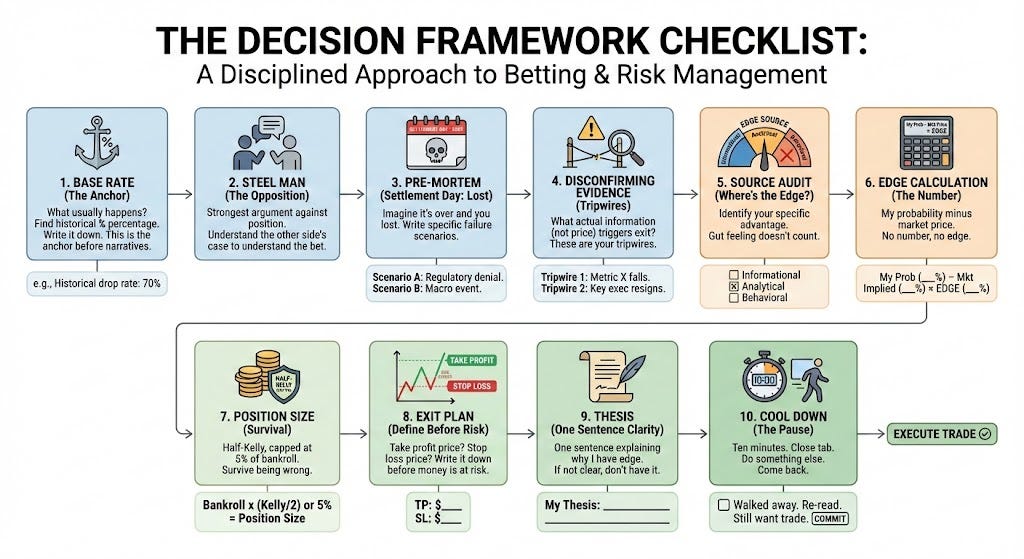
The protocol I use - the one I should have used more carefully on Warsh - takes about forty-five minutes.
I open a blank doc. Type the contract at the top. And then I answer ten questions before I’m allowed to buy anything:
Base rate. What usually happens in situations like this? Find the historical percentage. Write it down. That’s the anchor before narratives start.
Steel man. Strongest argument against my position. If I can’t make the other side’s case, I don’t understand the bet.
Pre-mortem. It’s settlement day. I lost. What happened? Write down the specific scenarios.
Disconfirming evidence. What information would make me exit? Not price movement - actual information. These are my tripwires.
Source audit. Where’s my edge coming from? Gut feeling doesn’t count.
Edge calculation. My probability minus the market price. No number, no edge.
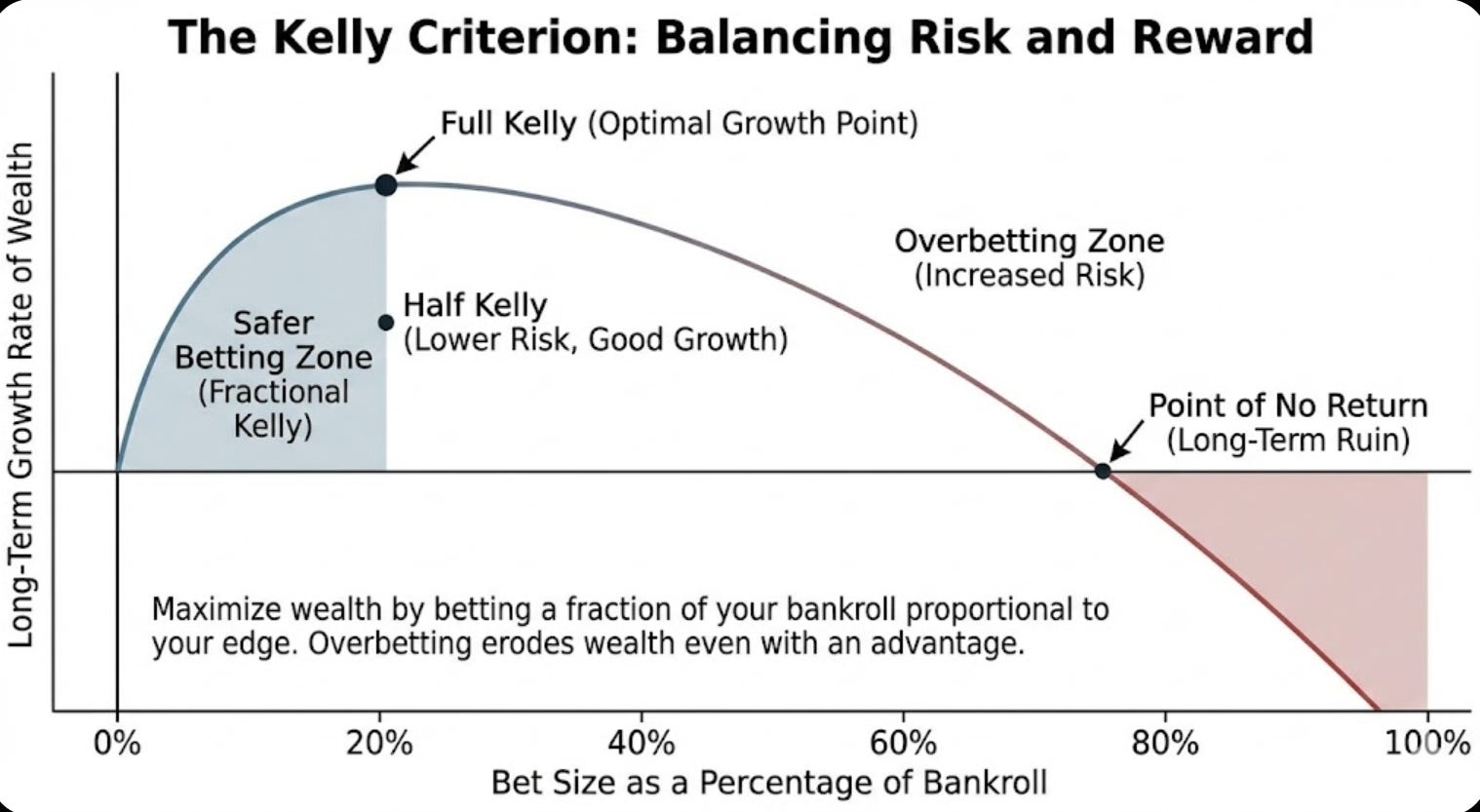
Position size. Half-Kelly, capped at 5% of bankroll. This is how you survive being wrong.
Exit plan. Take profit at what price? Stop loss at what price? Write it down before money is at risk.
Thesis. One sentence explaining why I have edge. If I can’t say it clearly, I don’t have it.
Cool down. Ten minutes. Close the tab, do something else, come back.
I wrote this down because I kept skipping steps. I’d see a contract, have a feeling, buy.
Lose money on vibes.
Instead I made an e-book, eleven pages, the ten questions, the Kelly math, a pre-mortem template.
The 75¢ Dollar Framework. Read it. Print it out. Stick it next to your screen.
Then I realized I’d still skip steps if the only thing stopping me was paper. So I built software that won’t let me.
EDGE Terminal pulls live contracts from Polymarket or Kalshi. Surfaces the Boring Middle. Forces you through the checklist - every question, no skipping.

The AI does the arguing I’m too lazy to do myself: finds the base rates, makes the case against me, tells me what I’m ignoring.
The Kelly calculator sizes the bet.
The timer makes you wait ten minutes.
You can’t skip steps. That’s the point. It’s the discipline I couldn’t trust myself to have.
On Warsh, I ran the protocol. Thesis was clear. Position size was small enough to lose without pain. What I maybe got wrong: the base rate.
How often does the “obvious pick” get picked? I anchored on qualifications without asking how often qualifications matter versus relationships.
Hassett might just know the right people.
VII.
There’s one more category I want to tell you about, because almost nobody is trading it yet. And because the CEO of Coinbase just proved it works.
Last month, at the end of Coinbase’s third-quarter earnings call, Brian Armstrong went off script. “I’ve been tracking the prediction market about what Coinbase will say on their next earnings call,” he told analysts. “And I just want to add here the words Bitcoin, Ethereum, Blockchain, Staking, and Web3 to make sure we get those in before the end of the call.”
He rattled off the words. Every mention market on Kalshi and Polymarket that bet on those words paid out instantly. $84,000 in total.
Armstrong was trolling. Some people called it manipulation. Polymarket called it “diabolical work.” But here’s what I saw: a CEO of a $60 billion company paying attention to mention markets. That’s not a joke. That’s validation.
Mention markets. Betting on whether a specific person will say a specific word during a specific event.
It might be the purest edge available to a retail bettor. Because the data exists and almost nobody is willing to read it.
I spent a weekend last month reading Federal Reserve press conference transcripts. Every FOMC presser since 2018. Forty-seven of them. My wife thought I’d lost my mind. Maybe I had.
I wasn’t reading for content. I was reading for language. Patterns. Verbal tics. It took six hours. By the end my eyes were glazing and I was talking to myself, but I had a spreadsheet.
Powell says “data-dependent” in 91% of pressers. Ninety-one. It’s a verbal tic - a phrase he reaches for when he wants to sound careful without committing.
He says “soft landing” in 23% of pressers.
He says “transitory” in zero pressers since November 2021, when the word became a punchline and he retired it forever.
Unlike Brian Armstrong, Jerome Powell isn’t checking prediction markets before he speaks. He’s not going to troll the bettors. He’s going to say “data-dependent” because he always says “data-dependent.” That’s not a bet on what he’ll do. That’s a bet on who he is.
If Polymarket lists a contract on whether Powell says “data-dependent” at the next FOMC, and it’s trading below 85 cents, you’ve found a 75¢ Dollar. The market would be underpricing a near-certainty you can verify from public transcripts.
This is what the Mention Builder is for.
Pick the person. Pick the event. Pick the word.
It runs the transcripts and gives you a number before you can talk yourself into anything.
Right now, mention markets are still niche. $84,000 on a Coinbase earnings call is nothing compared to the millions on elections. But that’s the point. Edges die when they get crowded. This one is just getting started.
VIII.
This is why they’re scared.
A week after the election, FBI agents raided the Manhattan apartment of Shayne Coplan, Polymarket’s 26-year-old founder. Seized his phone and electronics. No charges announced.
Théo, meanwhile, had a different problem.
“Disclosing my identity would disrupt my life,” he told a reporter. “My family and friends are not aware of the extent of my wealth. It will also seriously endanger my safety.”
The man won $85 million - more money than most people will see in ten lifetimes - and his first instinct was to hide. Not celebrate. Hide.
The platform that called the election correctly was under federal investigation. The man who made the right call was in hiding. The pollsters who got it wrong were on television the next morning, explaining why the miss was understandable, collecting their fees, booking next cycle’s contracts.
This is what happens when accuracy threatens institutions built on acceptable inaccuracy. The institutions don’t get more accurate. They get hostile.
IX.
I still have the tabs open. Warsh: 11. Hassett: 55 now.
The spread is wider than yesterday. My thesis is weaker than last week. And I’m doing what every bettor does in this situation: looking for reasons to believe I’m still right.
Maybe Hassett’s surge is noise. Maybe the reporting is wrong. Maybe Warsh is the quiet pick and the announcement shocks everyone.
Or maybe I was just wrong. Maybe 17 cents was the right price all along.
This is the game. This is what it feels like. Not the Théo story, where you skip to the end and he’s $85 million richer. The middle part. The waiting part. The part where you don’t know yet.
Théo’s somewhere in France now, figuring out how to spend $85 million without attracting attention. The pollsters are on television, being wrong with no consequences. And I’m on my couch, watching two numbers move, wondering if I know something the market doesn’t or if I’m just another dreamer with a thesis.
A fool and his money are easily parted.
Some days you’re the one taking. Some days you’re the fool.
The only way to find out is to do the work and wait.